Waiting to load…
Visualization
Gallery
Select a sequence, then drag to orbit, pan, and scroll to zoom around the reconstructed 3D trajectories.
Choose a sequence
0%
Select a sequence
Choose a sequence above to load its 3D reconstruction.
Frame – / –
Visualization powered by Three.js. Drag to orbit, right-drag to pan, and scroll to zoom.
Benchmark
Interactive Comparison
Compare OpenD4RT, 4RC, V-DPM, and UniQuery4R under synchronized time and camera controls.
Waiting to load…
Waiting to load…
Waiting to load…
Drag any panel to update all four viewpoints. Timeline playback and frame seeking are shared.
Paper
Abstract
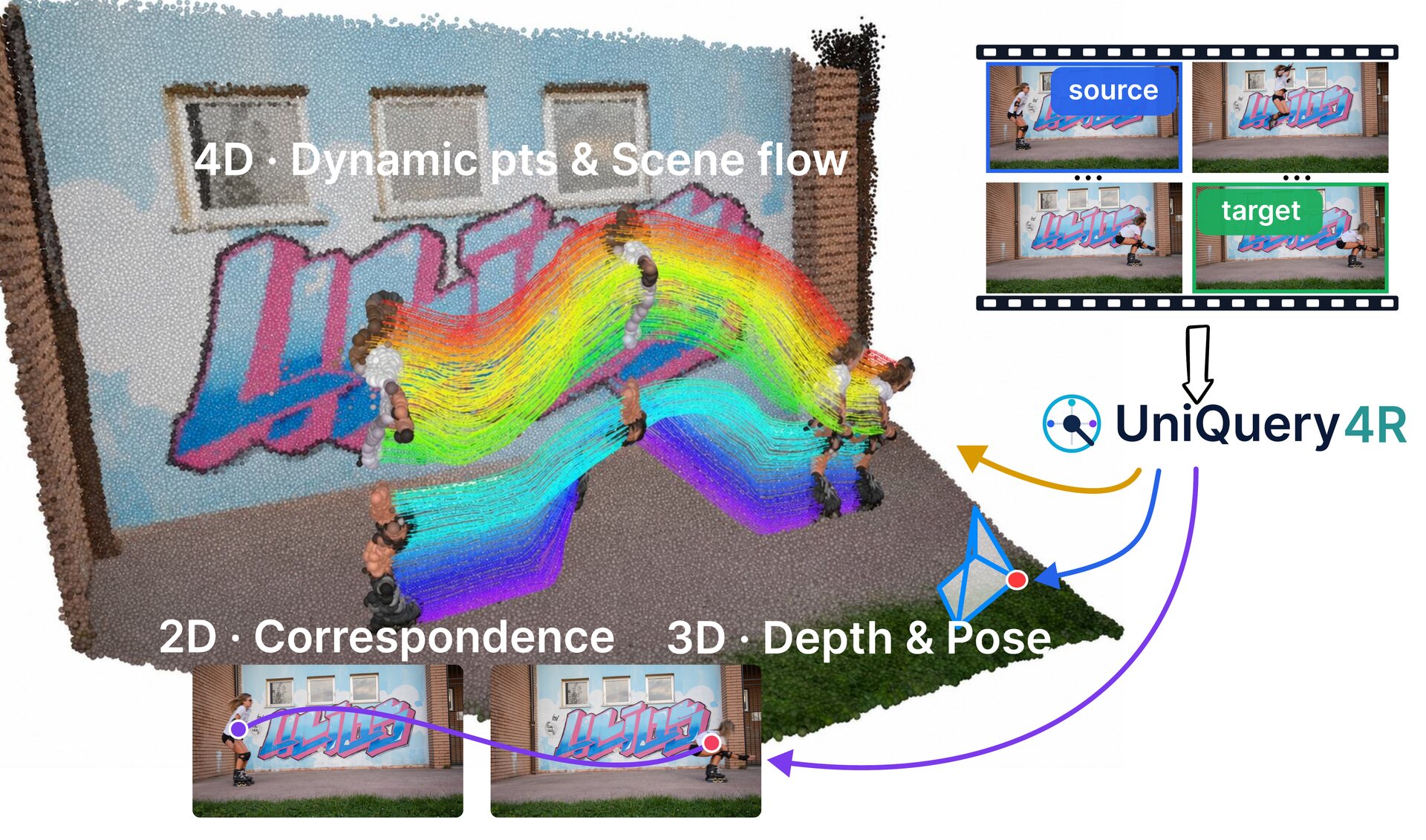
Reconstructing dynamic 4D scenes requires jointly estimating correspondence, geometry, object motion, and camera motion. Existing feed-forward methods typically predict dense task-specific maps or independently process source–target pairs, leading to unnecessary computation for sparse queries and limited feature reuse across different frame pairs.
We present UniQuery4R, a query-conditioned framework that encodes a multi-frame clip once and selects the source view, target view, and continuous source-image coordinate only at decoding time via source-to-target cross-attention. Each query jointly predicts target correspondence, target-time 3D position, and scene flow, along with source depth, while camera parameters are estimated per view.
This design allows the encoded clip to be reused across arbitrary source–target selections and supports both sparse inference and dense reconstruction through batched queries, without learned temporal embeddings tied to a fixed clip length. We further introduce a direction–magnitude parameterization of scene flow with separate supervision for moving and static points. Across four evaluation datasets, UniQuery4R achieves the best macro-average results among the evaluated methods for WorldTrack dynamic-point tracking and for our scene-flow evaluation derived from the same datasets.
Approach
Method Overview
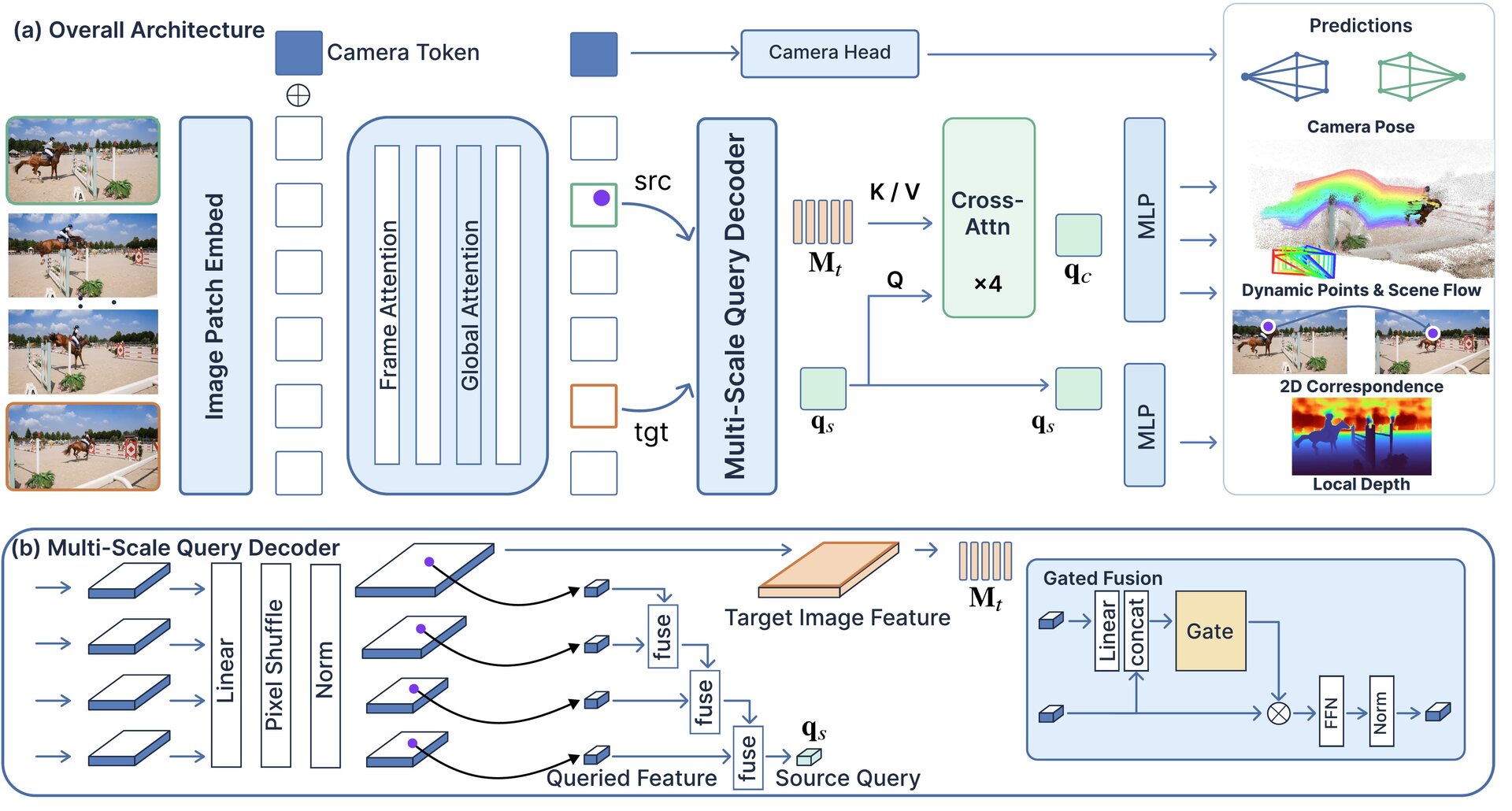
Encode once
All views are jointly contextualized before the query is known, allowing the same encoded clip to serve arbitrary source–target selections.
Query continuously
Bilinear multi-scale sampling preserves sub-pixel coordinates and provides one interface for sparse on-demand inference and dense reconstruction.
Attend source to target
The source query attends over the full selected target field, recovering correspondence without fixed temporal embeddings or predefined matches.
Evaluation
Results
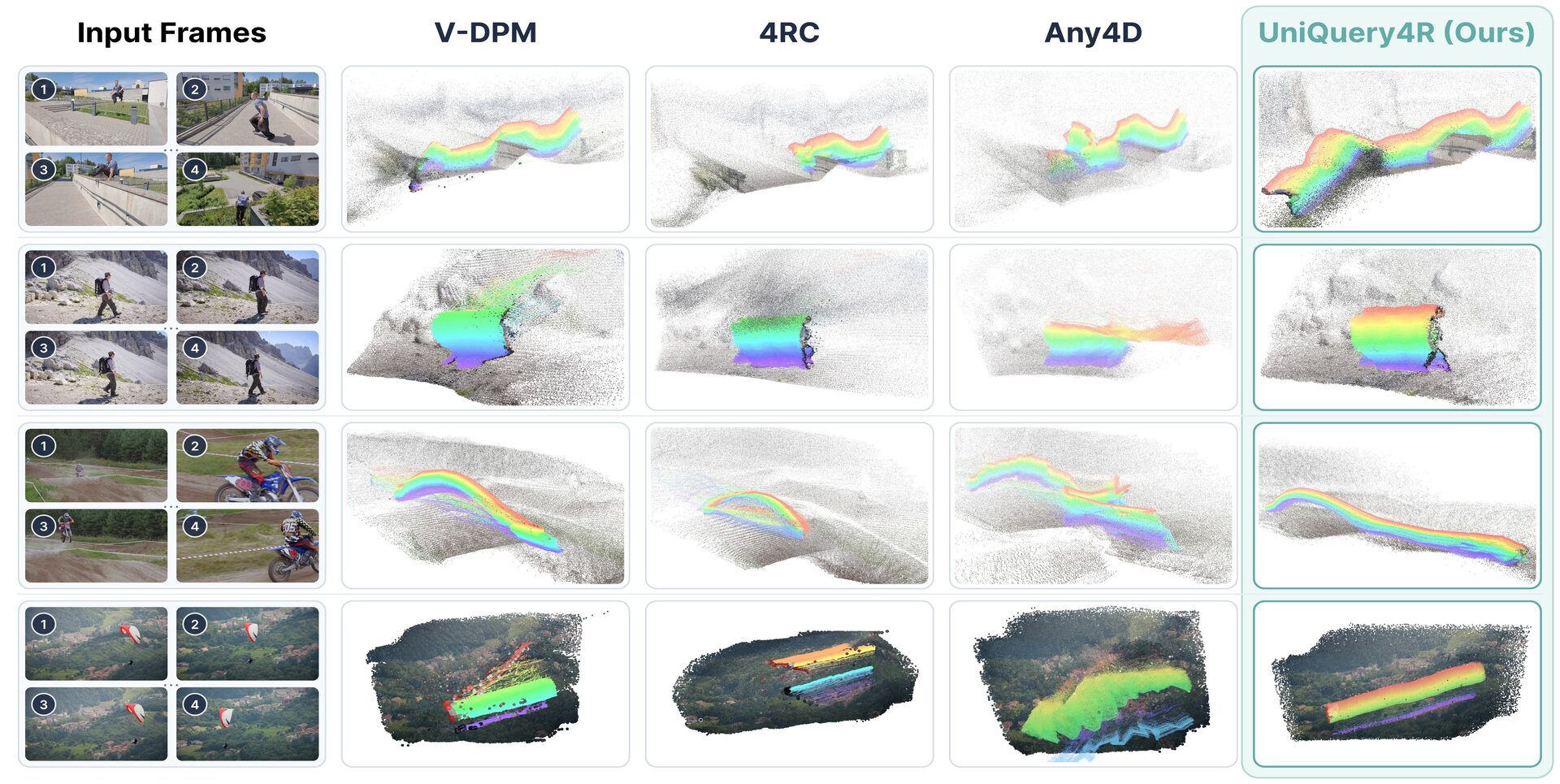
UniQuery4R achieves the best four-dataset macro-average results among evaluated methods for dynamic-point tracking under the WorldTrack protocol.
WorldTrack Dynamic-Point Tracking
APD (%) ↑ and EPE (m) ↓ across four datasets and their equal-weight macro-average.
| Method | PStudio | PO | DR | ADT | Macro Avg. | |||||
|---|---|---|---|---|---|---|---|---|---|---|
| APD ↑ | EPE ↓ | APD ↑ | EPE ↓ | APD ↑ | EPE ↓ | APD ↑ | EPE ↓ | APD ↑ | EPE ↓ | |
| SpatialTrackerV2 | 49.93 | 0.4639 | 53.45 | 0.5173 | 54.34 | 0.4368 | 69.39 | 0.2764 | 56.78 | 0.4236 |
| St4RTrack | 70.80 | 0.2479 | 67.38 | 0.314 | 74.24 | 0.2594 | 72.90 | 0.2958 | 71.33 | 0.2793 |
| TraceAnything | 70.86 | 0.278 | 39.37 | 1.0462 | 60.89 | 0.5642 | 75.69 | 0.2515 | 61.70 | 0.535 |
| Any4D | 74.72 | 0.2361 | 65.99 | 0.3783 | 76.72 | 0.3463 | 78.09 | 0.2378 | 73.88 | 0.2996 |
| V-DPM | 78.95 | 0.1757 | 80.82 | 0.1857 | 75.29 | 0.2438 | 85.47 | 0.1725 | 80.13 | 0.1944 |
| 4RC | 69.08 | 0.259 | 79.81 | 0.2353 | 84.65 | 0.1667 | 84.16 | 0.177 | 79.43 | 0.2095 |
| OpenD4RT | 78.63 | 0.1811 | 66.03 | 0.3398 | 76.78 | 0.2407 | 69.91 | 0.2966 | 72.84 | 0.2646 |
| UniQuery4R (ours) | 84.64 | 0.1333 | 83.74 | 0.1604 | 80.00 | 0.2078 | 87.17 | 0.1387 | 83.89 | 0.1601 |
DAVIS Visualization
Reference
BibTeX
If you find UniQuery4R useful, please cite our work.
@article{chen2026uniquery4r,
  title   = {{UniQuery4R}: Unified {4D} Scene Reconstruction from a Single Query},
  author  = {Chen, Tiancheng and Tang, Sheng and Jin, Wenhua and Zhang, Weiqi and Fang, Juntong and Zhou, Junsheng and Li, Zesong},
  journal = {arXiv preprint arXiv:2608.17283},
  year    = {2026}
}